The truck that can see your open space is the truck that fuels.
Argus Park counts your lot space by space on the cameras you already own and shows the number to drivers while they are still on the highway. Argus Pass bills the stays that never buy anything, without a gate or a person in the lot.
Talk to us about your sites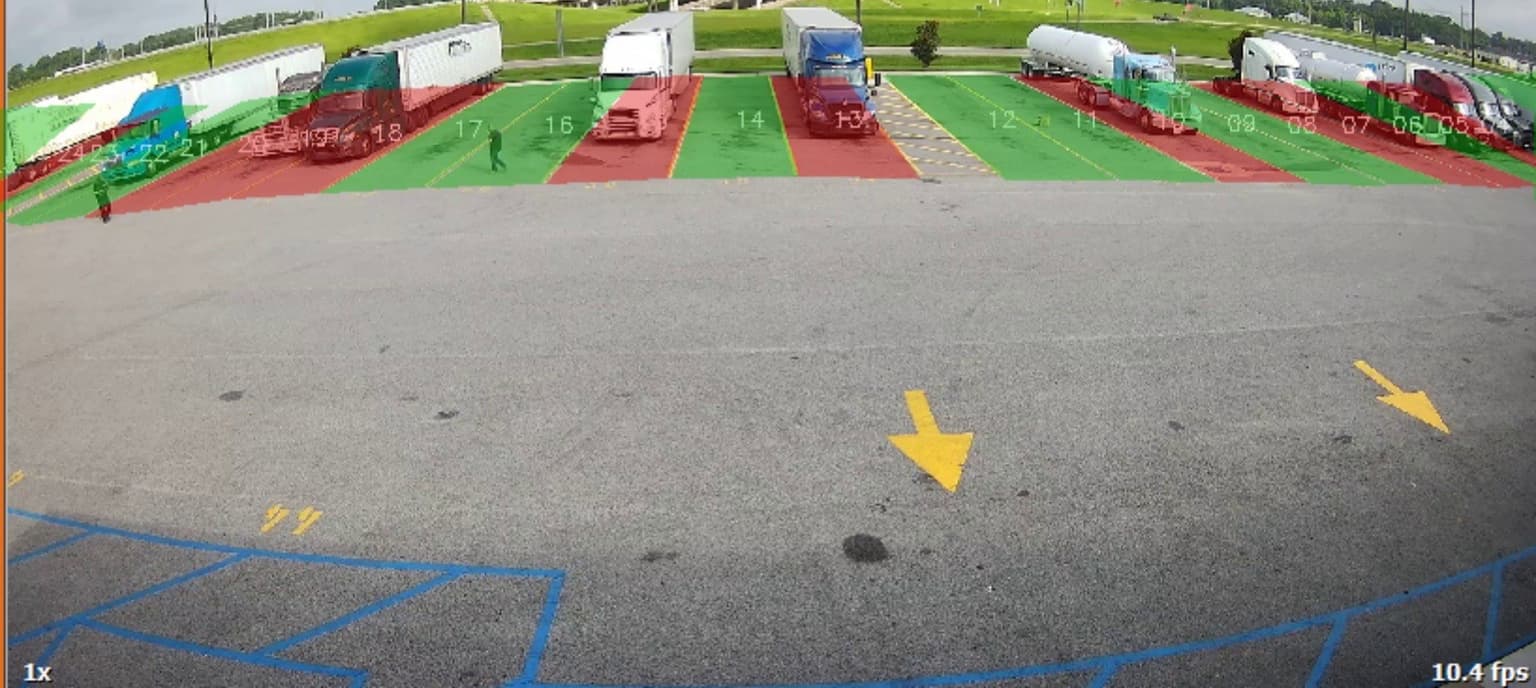
A live truck stop lot on its own security camera. 34 of 35 spaces correct.
Parking pulls the truck in. The store makes the margin.
A driver picks the stop they know they can park at. When your live count is in the app, your lot is the one they route to, and the truck that parks is the truck that fuels and shops. A reserved or comped space tied to a fuel purchase is the strongest offer a travel center can make, and it costs nothing when the cameras already know which spaces are open.
The lot also hosts trucks that never come inside. Dropped trailers, three day stays, units from a carrier down the road using your pavement as a terminal. Argus Pass reads the carrier off the door and bills those stays, with a fifteen minute grace period and an account offer, while the lot stays open and ungated for everyone else.
Most operators start with Pass because the billing pays for the cameras, then turn on Park to feed their own signs, their website, and the drivers looking for them.
| Time | Trucks | Lot full |
|---|---|---|
| 10:00 | 2 / 20 | 10% |
| 14:00 | 9 / 20 | 45% |
| 18:00 | 16 / 20 | 80% |
| 22:00 | 20 / 20 | 100% |
Sample readings from a live occupancy feed on a 20 space rest area lot. The same feed stands up on a truck stop in days, then you get the live dashboard.
The agent fills the lot. The cameras see it. The bill sends itself.
Three products, one set of cameras. Install once and run any of them. Most operators start with Argus Pass because it pays for the cameras.
Fill the lot.
A voice agent inside the Argus driver app. It watches the route and the clock, finds a space ahead, and reserves and pays for it while the truck is still moving.
- Prepaid demand routed into your lot
- The driver never opened a listing
- Your lot listed everywhere drivers look
See the lot.
Computer vision counts open spaces down to the individual stall and publishes it live to your systems, your signs, and the drivers looking for you.
- Space level occupancy, not a lot level guess
- 97% accuracy against ground truth on a live lot
- Runs on the cameras you already own
Earn from the lot.
The same cameras document every truck on entry and exit, and we bill the carrier for the stay. Think PrePass for parking.
- No gate, no kiosk, no attendant
- Billed to the carrier by USDOT number, not to the driver
- We invoice, we chase, we collect
Existing cameras. No one at the gate. Measured, not modeled.
We tested the two things a lot operator cannot see today without someone at the gate: which trucks are on site, identified by the USDOT number on the cab door, and which spaces are open, space by space. Both ran on the fixed security cameras the sites already had. None were installed, moved or aimed for this work.
The model reading a live feed. Each numbered space is classified on every frame. Results from overlapping cameras are merged into a single lot view, and a space no camera can see is reported as unknown rather than assumed open.
Parking availability
On a live truck stop lot the system classified each truck space as open or occupied and was validated space by space against ground truth. The run lasted five continuous hours from night into day with no change in setup. The one miss sat at the far edge of a single camera's view, the case a second overlapping camera removes.
Read rate by camera placement
- In camera read range, measured100%4 of 4 trucks in the fuel island and canopy close zones
- Whole site, cameras placed for security73%11 of 15 identifiable trucks, no camera moved or aimed for this
- Whole site, one camera per two stalls87 to 93%87 to 93%, modeled from close zone performance on the same 1080p hardware
Gold is measured. Blue is a projection. Every truck that presented a readable door inside a camera's read range was identified.
Truck identification
Seven hours of video from three existing 1080p security cameras, daytime. A number is accepted only when it sits next to a visible USDOT label, is corroborated across frames, and matches the federal registry with no competing reading. When evidence is ambiguous the system reports nothing and keeps an evidence photo. Trailer, MC and equipment numbers were all correctly withheld.
Availability tells you how many spaces are free. Identification tells you who is in them and for how long. Together they give an unmanned yard what a staffed gate gives a manned one: a check in and check out record for every truck, dwell time per carrier, and a count of spaces used against spaces booked.
Live availability on the cameras the state already streams.
Argus Park runs on public rest area cameras today, detecting and counting every truck against the stall map and publishing occupancy continuously. That feed drives the highway sign before the exit, the 511 system, and the count a driver sees in the app, with no in ground sensors to trench.
The first dedicated federal truck parking line item, $200 million in FY2026, scores live availability sensing as a merit criterion. A camera based count on existing infrastructure is the fastest way to qualify a corridor.
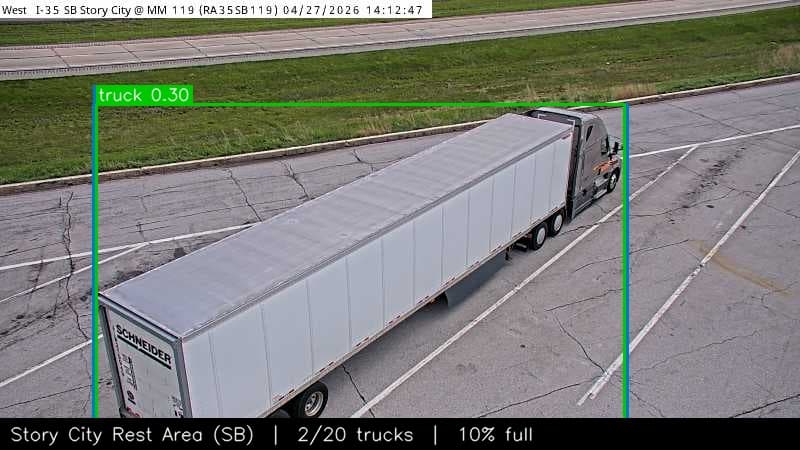
A public rest area camera on a Midwest interstate. Every truck is individually detected, confidence scored, and counted against the stall map.
Your cameras, or ours.
- 1. Survey. We survey the existing cameras and mark which spaces and gate lanes they cover.
- 2. Fill the gaps. Add coverage only where the survey shows one. A lot with a single entrance needs one camera, and it reads both directions, so arrivals bill and departures free the stall.
- 3. Map once. The spaces are mapped once, then the site is live. Zero servers on your property. Processing runs at the edge and on our platform.

Argus is an Axis Communications Authorized Partner. New installs run on Axis network cameras, which are NDAA compliant and are what most enterprise security teams already standardize on. Any RTSP or ONVIF camera already on the lot becomes a sensor.
Questions truck stop operators ask
Should a truck stop charge for parking?+
The money at a travel center is inside the store, so the lot exists to pull the truck in. Argus Pass lets you keep the lot open and first come first served while billing the stays that never buy anything, and comp or discount the ones tied to a fuel purchase. Drivers who fuel park like they always did. Drivers who drop a trailer for three days get an invoice.
How do I show drivers that my lot has space?+
Argus Park reads occupancy space by space from your cameras and publishes it live. Drivers see the count in the Argus app while they are still on the highway, and the Argus Agent can reserve a space for them before they arrive. The same feed drives a sign at the exit, your own website, and marketplace listings.
How accurate is the count?+
On a live truck stop lot, 34 of 35 spaces correct against ground truth over five continuous hours from night into day on two existing cameras. The one miss was at the far edge of a single camera view. Other availability feeds refresh every two hours from bookings. This one refreshes from the camera.
Can rest areas use this?+
Yes, for availability. Argus Park counts on the cameras a DOT already streams and publishes live space counts to TPIMS style signs, 511 systems and the app. It runs on public rest area cameras today. Tolling is for private lots.
Will this replace my reservation system?+
Only if you want it to. Argus connects to an existing reservation system, carrier accounts, or payment processor and runs the rest. Most independents have none of those, so Argus runs the whole ledger.
How many cameras does a truck stop need?+
Four to five positions cover a typical truck stop lot. Existing security cameras are surveyed first and coverage is added only where the survey shows a gap. Argus is an Axis Communications Authorized Partner for new installs.
What do I get from the fuel island?+
The same cameras that count the lot can measure fuel island throughput, dwell and queue, which is operational visibility most sites do not have today. That layer is in build. Parking availability and billing are live.
Start with one site.
Tell us how many sites, how many spaces, and what cameras are up. We reply within one business day with a site read and what the first ninety days would look like.
Prefer a call? Robert Putt, founder. 402 915 2886 or robert@getargus.ai.