Truck parking revenue on land you already own. Nobody enters the building.
Pavement, a fence and the cameras already on it are the whole install. Argus bills the carrier for every stay, counts the spaces so you know what is left to sell, lists the lot where drivers look, and keeps the occupancy record that makes the income count at the sale.
Get a read on my property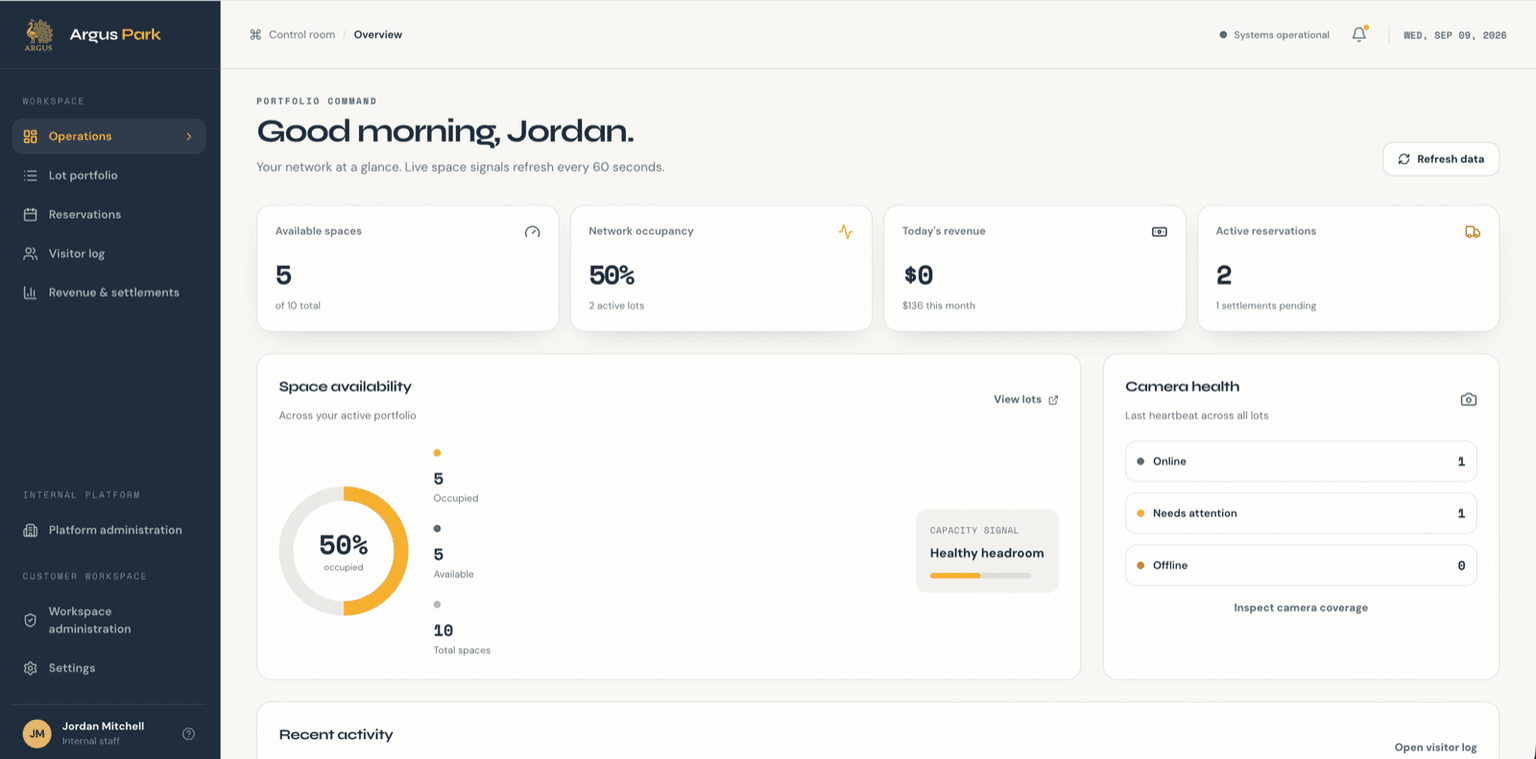
The console. Spaces open, occupancy, revenue booked today and camera health, every lot on one screen.
Improve the NOI. Then sell the lot with the revenue attached.
Industrial outdoor storage trades on NOI and cap rate. A parking revenue line that costs software and a camera survey to start, and that carries no tenant inside the building, moves the number a buyer underwrites. The broker version of the same idea is simple: buy the property, turn the cameras on, generate parking revenue, and flip it with the income documented.
The second half is the gap most owners admit to. They have no truck parking marketing function. Argus gets the lot listed across the parking marketplaces, keeps the availability current from the cameras, and books drivers into it from the cab. The pitch is demand and revenue, not software.
Occupancy truth instead of booking math. The gap between what was reserved and what is physically parked is usually where the revenue leak is, and it is the number a lender asks for.
Real time availability
Space level occupancy read directly from the cameras. Any RTSP or ONVIF camera already on the lot becomes a sensor.
Know who is parked
The USDOT number on the cab door, confirmed against the federal registry. Every arrival resolves to a carrier: company name, authority status, fleet profile.
Lot compliance
Match what the cameras see against what was sold. Unauthorized vehicles, overstays and unpaid occupancy surface with photo evidence, and Argus Pass bills them.
Reporting owners actually use
Daily occupancy, turnover, busy windows and utilization by zone, kept as history. The same record supports NOI documentation, lending and acquisition diligence.
What the pavement bills.
Put in the space count and the rate you would post. This is gross billed parking before Argus fees.
Defaults sit in the middle of the rates lots publish today: $15 to $25 a night and $150 to $300 a month for a tractor trailer space, higher in coastal metros. Your numbers replace ours. This is gross billed parking before Argus fees, and it counts only the trucks already parking with you.
- 45 nightly spaces at 65% full
- $17,550
- 15 contract spaces
- $3,375
- Per year
- $251,100
Every lot, every truck, one screen.
Spaces open, occupancy, revenue booked today, and camera health across the whole portfolio.
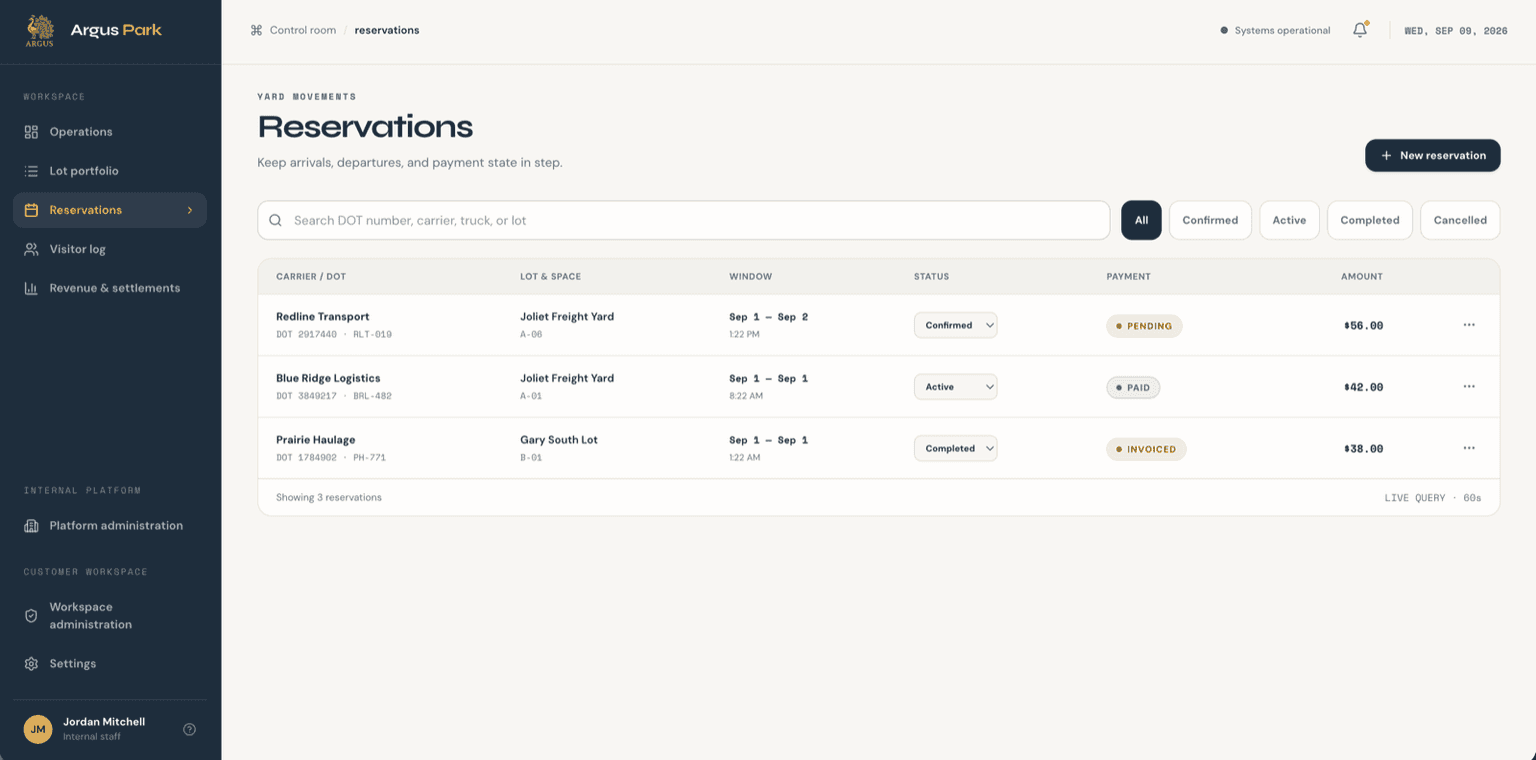
Carrier, DOT number, space, and payment state.
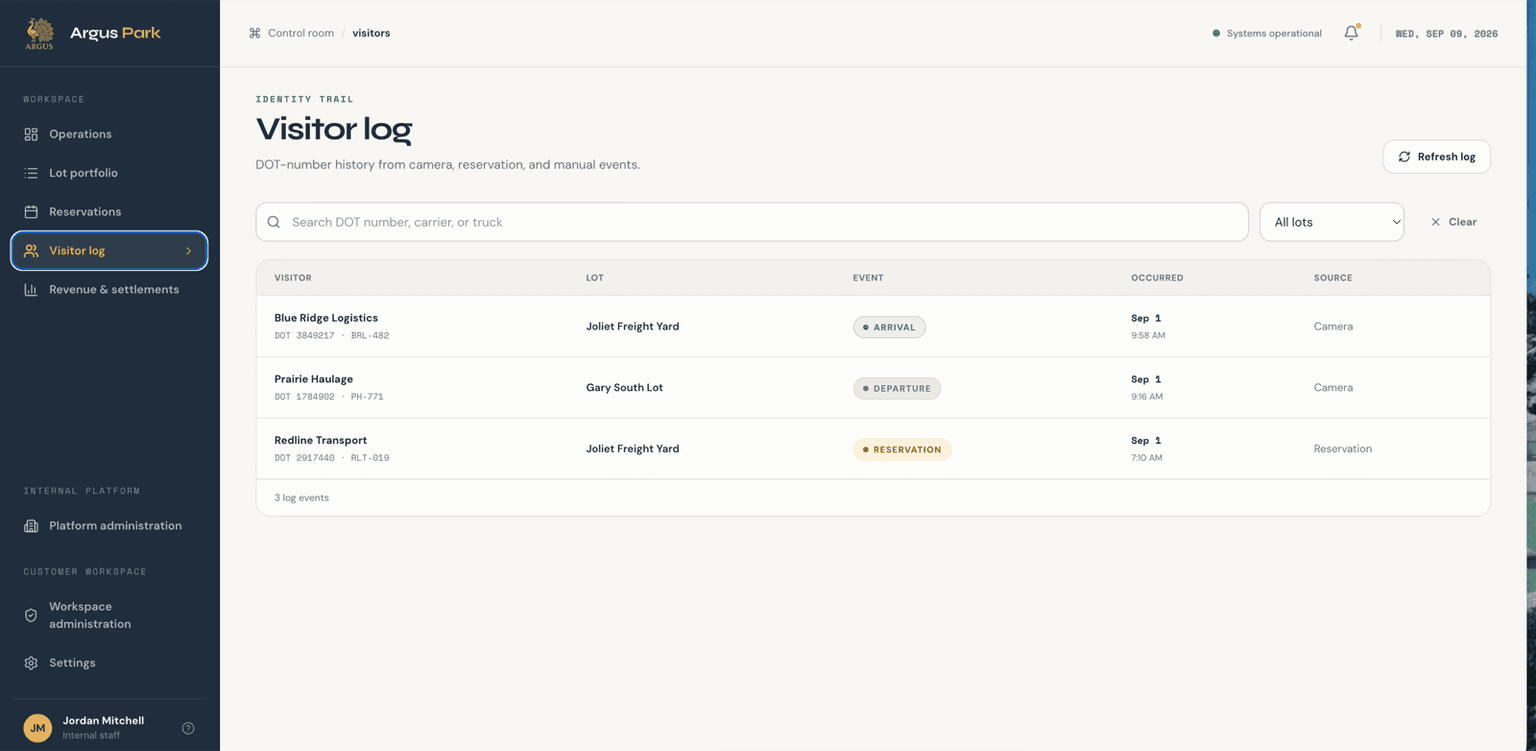
Every arrival and departure, sourced from the camera.
We run all six layers. Or only the ones you lack.
If you already have an inventory system, carrier accounts, or a payment processor, we connect to them and run the rest. Nothing gets ripped out.
Computer vision
Detection, USDOT and plate reads, entry and exit pairing, image retention.
Always ArgusCarrier identity
USDOT lookup against the federal registry, contact resolution, carrier record.
Always ArgusCommunications
The text, the email, the grace period clock, and the reminders that follow.
Always ArgusInventory and availability
Live space counts and rate rules. We publish into your system or run the whole ledger.
Yours or oursAccounts
Carrier signup and credentials. We federate to your existing accounts if you have them.
Yours or oursPayments and collections
Card on file, invoicing, dunning, escalation. We settle to you or route through your processor.
Yours or oursYour cameras, or ours.
- 1. Survey. We survey the existing cameras and mark which spaces and gate lanes they cover.
- 2. Fill the gaps. Add coverage only where the survey shows one. A lot with a single entrance needs one camera, and it reads both directions, so arrivals bill and departures free the stall.
- 3. Map once. The spaces are mapped once, then the site is live. Zero servers on your property. Processing runs at the edge and on our platform.

Argus is an Axis Communications Authorized Partner. New installs run on Axis network cameras, which are NDAA compliant and are what most enterprise security teams already standardize on. Any RTSP or ONVIF camera already on the lot becomes a sensor.
Questions property owners and brokers ask
How much can I make renting land to truckers?+
Published rates for a tractor trailer space run $15 to $25 a night and $150 to $300 a month, with coastal metros higher. Trailer only storage is quoted around $75 to $200 a stall a month. Per acre, operators quote $5,000 to $8,000 a month gross on a full paved lot. The estimator on this page turns your space count and rate into a monthly figure.
How many truck spaces fit on an acre?+
A paved acre laid out for tractor trailers holds roughly 25 to 35 spaces depending on drive aisles and whether trucks pull through or back in. The camera survey maps the spaces once, and that map is what Argus Park counts against.
Do I have to run this myself?+
No. Argus runs the vision, the carrier identification, the notifications, the billing and the collections. If you already have a booking system, carrier accounts or a payment processor, we connect to them and run the rest. You see every lot on one console.
What about the risk?+
Nobody enters a building. Trucks park on pavement you already own, the carrier is a registered business with a federal record, and every stay has paired entry and exit photos. The posted signage forms the agreement and Argus is named as the operator. It is the lowest risk revenue line an industrial property can add.
How do drivers find a lot that has never been listed?+
Argus lists it across the truck parking marketplaces and keeps the availability current from the cameras. Argus also builds a navigation app for truck drivers, and the Argus Agent reserves and pays for a space ahead on the route while the truck is still moving. Demand arrives from drivers who never went looking for a listing.
Does the parking revenue count toward NOI at sale?+
Camera verified occupancy history is what makes it count. Daily occupancy, turnover, busy windows and billed revenue are kept as a continuous record from the day the cameras go live, so the income is documented for lending and acquisition diligence rather than estimated from bookings.
Can I start with the cameras already on the fence line?+
Usually yes. Both field results Argus publishes came from existing 1080p security cameras that were never moved for the job. A survey marks what they cover, coverage is added only where the survey shows a gap, and a single entrance lot needs one camera that reads both directions.
Tell us about the property.
Acreage, surface, entrances, and what cameras are on the fence. We reply within one business day with a space map estimate and what the first ninety days would bill.
Prefer a call? Robert Putt, founder. 402 915 2886 or robert@getargus.ai.